
Why mistakes can help us all to learn
30 May 2022
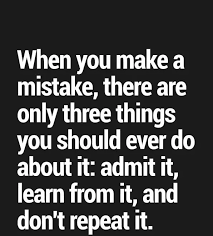
You’ll know the old poem by Rudyard Kipling called If.
It was written more than 100 years ago and is considered to be one of the greatest of its era.
In it, a father outlines some of the values his son will need to live a good, fulfilling life.
Two of the most famous lines are these:
“ If you can meet with triumph and disaster
And treat those two impostors just the same…”
It’s good advice – keep your feet on the ground when things go well and don’t beat yourself up too much when they go off the rails – but how many of us actually follow it, particularly in the workplace?
It can be all too common in this country for mistakes in the workplace to be blown out of all proportion by managerial structures which penalise error rather than create the space for invention or innovation.
We discuss some of the reasons for this in our employer’s blog this month, but it’s worth looking at what employees can do to build their own resilience at work and learn how to deal with mistakes so that they do not drain us of our enthusiasm and motivation.
The first step, of course, is to understand that mistakes are inevitable. Part of being a human is that we make errors – but that we also try to learn from those mistakes so that we do not keep repeating them.
So, rather than seeing mistakes as a complete failing in ourselves and something to be ashamed of and possibly conceal, we should put them in their more natural context of being part of our personal development and growth.
This does not mean, of course, that we minimise the impact that mistakes can have. But rather than set them in a context of blame we should seek to understand and analyse them, see how they happened and learn from the experience so that it is not repeated.
One way to accept this is to think about the first time you did something as a child – rode a bike, got on a skateboard or tried to swim, for example. My bet is that you made plenty of mistakes and very quickly began to process what you needed to do to get better at the new skill. The number of people who master something almost at once is vanishingly small.
This approach to making mistakes should not allow for complacency. (Nobody wants to keep falling off their bike and injure themselves and possibly others…) The point is not to set out to make the errors but to learn from them when they happen and to think in evolutionary terms – what can I learn from this – rather than the fixed terms of ‘I should be able to do this’.
Adopting this mindset is good for us as employees – and good for the businesses we work in. It encourages a more inquiring mindset, a desire to learn and develop and when placed into a team context can help reduce conflict and the blame game.
When adopted by managers and embedded in a healthy company culture it can promote both individual and corporate resilience and help drive growth and ambition.
If you need help or support with any of the issues raised here, just press the button for a free consultation and let us do the rest.